









While browsing major websites, forums, blasphemic literature and discussion
threads online, we realize that not only Non-Muslims but some Muslims too are
indulging themselves in a very serious sin or act of blasphemy or hate words
against any religion whose reprecussions don't stop at an individual or an
organization but go onto whole humanity. Looking at this subject's importance we
should explore it further and find the answers that pacify our questioning
souls.
AS PER CHRISTIANITY & JUDAISM
The punishment for blasphemy in most of the major religions is death. It is
stated in the Old Testament of the Bible, which is the authority for both the
Jews and the Christians:
And he that blasphemeth the name of the LORD, he shall surely be put to death,
and all the congregation shall certainly stone him: [Book of Leviticus 24:16]
AS PER HINDUISM
In the religious book of Manusmriti, the Law book of the Hindus, it says:
“If a man born of a lower class intentionally bothers a priest, the king should
punish him physically with various forms of corporal and capital punishment that
make men shudder.” [Manusmriti 9:248]
AS PER ISLAM
Regarding the punishment for blasphemy in Islam, it is mentioned in the Glorious
Qur’an:
“The punishment of those who wage war against Allah and His Messenger, and
strive with might for mischief through the land is: execution, or crucifixion,
or the cutting off of hands and feet from opposite sides, or exile from the
land: that is their disgrace in this world, and a heavy punishment is theirs in
the Hereafter;” [Surah Al-Maidah 5:33].
Hence, it is only Islam that gives 3 different options for blashphmy and
apostacy punishment in addition to death.
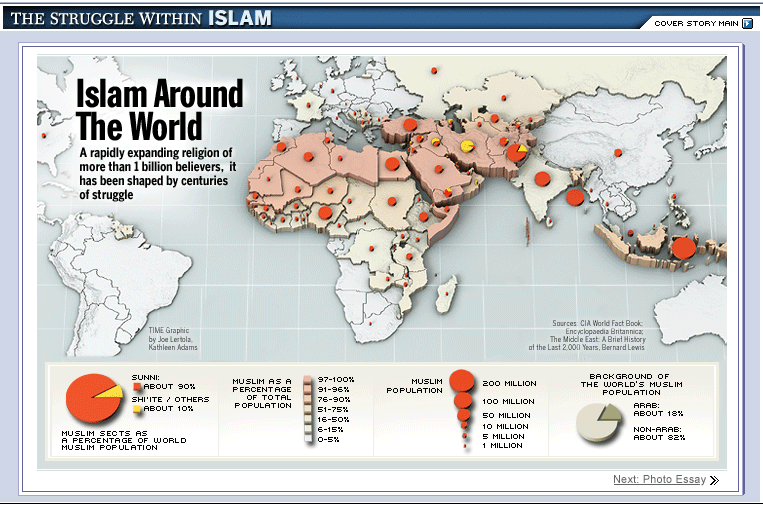
In spite of all the negative propaganda against Islam, ironically Islam still
happens to be the fastest growing religion, not just in the west but also across
the world. The more people try to suppress Islam, the more it will prevail.
Allah (swt) will make His Deen (Islam) to prevail over all the other ways of
life irrespective of people mocking and ridiculing His messengers. As Allah says
in the Glorious Quran:
“Mocked were (many) Messengers before thee; but the scoffers were hemmed in by
the thing that they mocked.” [Surah Al-An’aam 6:10].
As a common Muslim or a peace-loving human being, we can also use the following
tactics to stop this type of religious blasphemy;
1. Replies via the Media
The first way is to reply via the media i.e. using the same tool, which is often
used against us. Replies can be in the form of letters, articles, pamphlets and
books, which can be sent to newspapers and magazines and posted on the Internet.
Appearances on satellite TV channels and giving public lectures in order to
present the correct picture of Islam are also another possible way. Common
non-Muslims throughout the world have become victims of a section of the media
and its propaganda. One cannot blame a common non-Muslim for being against Islam
unless we Muslims clarify their doubts and remove the misconceptions prevalent
in their minds. It is the job of every Muslim to respond to allegations against
Islam and clarify misconceptions.
2. Peaceful Protests and Demonstrations
There can be peaceful demonstrations or protests in the form of a congregation.
A large number of Muslims can march to parliament house and protest against what
has happened. Muslims can also give a letter to the embassy of that particular
country and request the Prime Minister to take action against the offender.
3. Filing a Legal Suit
We can even take legal action against the defamer in his country or file a case
in the International Court of Law if the nation where the act has taken place is
condoning the act. We can sue the offenders by pulling them to court, which is
one of the good ways of preventing such things from occurring in the future.
A striking example in this respect can be cited of CAIR (Council on American -
Islamic Relations), which is the largest Islamic civil liberties group in the
U.S. In 1997, CAIR succeeded in shaking down Nike when they filed a defamation
suit objecting to a pair of shoes manufactured by Nike, which had a design on
the heel similar to the Arabic word for “God”, Allah. However, there was an
out-of–court settlement and Nike not only publicly apologized but also agreed to
give several million dollars to the Muslim community, which were spent to build
three playgrounds at Islamic Centers in the United States.
4. Economic Embargo
The fourth strategy is to put an economic embargo, a very effective weapon aimed
at weakening the economy of any country. Muslim countries can get together and
apply economic or business pressure against that country if it continues to
publish defamatory things. It is advisable to boycott certain goods if we know
that boycotting products of that country can create a huge effect on the
country’s economy. During the gulf war, a few countries in the Middle East
boycotted American products and caused a big loss to the U.S. If a section of
the western media has “freedom of expression” then we Muslims too have the
freedom to use or abstain from using a product. Say for example if the western
countries wish not to procure oil from the Muslim world, it is their choice for
which we cannot compel them. Similarly, if the Muslims do not want to buy
products from a particular country, it is illogical for anyone to have any
objections to their decision.
5. Political Pressure
This takes place on a higher level i.e. between political authorities of
countries. The leaders of different Muslim nations can apply pressure on a
political level. The Muslim governments can withdraw their ambassadors from that
country and shut down its embassies as part of a political boycott, if they
refuse to give a public apology and do not stop defaming the Prophet (pbuh).
6. Moderate Force
The sixth strategy is to carry out demonstrations using a limited amount of
force. As far as the first five strategies are concerned, no Muslim or
non-Muslim can have any objections. If there is freedom of speech then we
Muslims also have the freedom to reply in the media, to participate in peaceful
demonstrations, or take legal action seeking punishment or compensation. We can
even boycott goods or apply political pressure since it’s a matter of personal
choice.
Adapted from
http://www.islamicvoice.com/April2006/QuestionHour-DrZakirNaik/
A Synthesis of the Islamic Law of Blasphemy/Apostasy
by Sayyid Muhammad Rizvi
In the name of Allăh, the Beneficent, the Merciful.
May Allăh send His blessings upon Muhammad & his progeny.
The issue of apostasy (irtidăd) and the punishment that Islam has prescribed for
an apostate is one of the least known and understood part of the shari`ah
(Islamic laws). After the concept of jihăd, apostasy is most frequently cited by
Christian missionaries as a negative dimension of Islam.[1]
In 1997, a question was forwarded to me by the Aalim Network of Ahlul Bayt
Discussion Group (ABDG) about the punishment given to an apostate. I could sense
the plea for understanding the law of Islam and the rationale behind that law.
And since, it is a very complex and sensitive issue, I wrote a detailed answer
using the notes I had from a talk that I had given in Toronto in May 1990. Few
months after this answer was circulated via the internet to the ABDG
subscribers, I wrote another article in June 1998 giving further details from
the jurisprudential point of view.
What you see in your hand is the collection of these two articles. First we
shall explain our view about faith in God and whether or not Islam can be
forcefully imposed on others; then comes the Islamic view on the choices a
person has after he has willingly joined the Islamic faith. Next, we shall
discuss the issue of apostasy and its two categories; followed by the religious
sources for the punishment of an apostate. The treatise ends with a discussion
on some Qur’ănic verses and some relevant issues about minorities in the Muslim
countries.
Notes:
[1] These missionaries seem to forget the infamous Inquisition, witch-hunting
and witch-burning rituals perpetuated by their forbearers when Christian rule
prevailed in post-Muslim Spain.
Faith in God: a natural instinct
According to Islam, every child is born with the innate ability to know and
believe in his Creator; this cognition has been placed by God into his nature (fitra).
The Qur’ăn describes the human soul in a very beautiful way. After swearing by
the most majestic signs of God’s creation, it says:
“…and by the soul and He who perfected it! Then He inspired to it (the ability
to understand) what is good for it and what is evil for it. Successful is he who
purifies it, and failure is he who corrupts it.” (91:1-10)
Almighty Allăh has made our souls such that we are able to distinguish between
what is good and what is evil. But for human soul to function on its fitra,
there is a condition–it must be kept pure, it must be immunized against
spiritual corruption. The soul is like a bulb which can give light provided it
itself is not surrounded with a thick cover or dust; every human being has that
light in his soul; however, those who keep it pure can enlighten their path with
it while those who allow the `spiritual dirt’ to gather upon it cannot see the
path towards Allăh. (Incidentally, kufr (infidelity) literally means a cover,
and so it implies that kufr prevents the inner light from showing the right
path.) The Prophet of Islam emphasized the same point when he said, “Every child
is born with the believing nature (al-fitra), it is his parents who make him
into a Jew or a Christian.”[2]
Besides this fitra, Allăh has also provided us with various means to know Him
and believe in Him; He sent prophets and messengers, He revealed the scriptures,
and above all He created thousands of signs in the nature which remind us of
Him. “Soon We shall show them Our signs on the horizon (ăfăq) and in themselves
(anfus), until it becomes clear to them that this is the Truth.” (41:53)
Notes:
[2] Al-Kulayni, al-Usul mina ‘l-Kăfi, vol. 2, p. 13; al-Bukhări, Sahih, vol. 2
(Beirut: Dăr al-Fikr, 1401) p. 104; for its Arabic edition with English
translation, see vol. 2 (Beirut: Dăr al-`Arabiyya) p. 262.
Can Islam be forced on others?
Having accepted that from the Islamic point of view, faith in God is ingrained
in human nature, and that it is only the parents and the society that corrupt
the soul and divert it from the Right Path, the question comes: Can Islam be
imposed forcefully on non-Muslims? Or we may even ask: Is the minor jihăd a
means of imposing the faith of Islam on non-Muslims?
I do not intend to get into the issue of the minor jihăd; but, briefly stated,
the majority of Sh`iah jurists (mujtahidin) do not believe in initiating a jihăd
without the clear permission of an infallible (ma`sum) Imam. Even those who
allow the initiation of jihăd, do not believe that jihăd can be used to impose
Islam on non-Muslims. At the most, they say that jihăd can be initiated to
remove tyranny and oppression from a non-Muslim society in order to eliminate
the factors that prevent the Divine message from reaching to the masses. Jihăd
cannot be used for imposing Islam on others; it is just for putting an end to
the aggression on Muslims or for helping the oppressed non-Muslims. (The history
of Muslims bears out this idea; an unbiased historian can clearly separate the
spread of the Muslim rule over areas outside Arabia by military might and the
spread of Islam without force in those same regions.)[3]
The Qur’ăn clearly says that, “There is no compulsion in the religion.” (2:256)
What this verse actually means is that: “There is no compulsion in (accepting)
the religion (of Islam).” Why? The verse continues, “Surely the Right Path is
clearly distinct from the crooked path.”So Muslims can always show the
difference between the right and the wrong paths, but not force the non-Muslims
to accept Islam. The Prophet of Islam has also been mentioned as a reminder, not
as a person who forces Islam upon others. “Therefore, you remind (them), for you
are only a reminder; you are not a watcher over them.” (88:21-22)In many other
verses, the Prophet is described as “a bearer of good news and a warner of God’s
punishment.” (2:119) His role was just to remind the people about their natural
instinct of believing in God. Force is not needed because the right way is
clearly distinct from the crooked way. Even during the conquest of Mecca, the
idol-worshippers were given a grace time of four months to study Islam, and
thereafter either become Muslims by their own choice or leave the sacred
city.[4]
Notes:
[3] See Ira M. Lapidus, A History of Islamic Societies (Cambridge: CUP, 1988) p.
243-244; M. Hodgson, The Venture of Islam, vol. 1, p. 199. For more details, see
my “How Did Islam Spread? By Sword or By Conversion?”
[4] See Chapter 9 of the Qur’ăn.
What after submission?
What we have said above was about accepting Islam, coming into the fold of
Islam. We have made it very clear that no one can be forcefully brought into the
fold of Islam; Islam cannot be imposed on any person or society. This was all
about a person who is outside the fold of Islam. Now we move on to the next
step. If a person is raised in a society which protects his soul from the
impurities of atheism (kufr) and polytheism (shirk), or if a person is shown the
Right Path and accepts it willingly — can such a person reject the Islamic
faith? Is he allowed to apostate (become murtad) and renounce Islam? Can he
declare that he does not believe in God or Prophet Muhammad or the Day of
Judgement?
Once a person enters into the fold of Islam, the rules change. As soon as you
become a Muslim by your own choice, you are expected to submit yourself to Allăh
totally and completely. “O You who believe! Enter into submission, kăffatan!”
(2:208) Kăffatan gives the sense of “all” and “completely”. Once a person
becomes a believer, he surrenders the right of making decisions to Allăh and the
Messenger: “No believing man and no believing woman has a choice in their own
affairs when Allăh and His Messenger have decided on an issue.” (33:36)
Even the question of apostasy, irtidăd or deserting of one’s faith, for a
Muslim, is a religious (shar`i) issue and even in this issue he is governed by
the laws of Islam. And Islam clearly says: No! You cannot become an apostate.
After coming into the fold of Islam, rejection of the fundamentals is not
tolerated. If there are doubts in your mind about the fundamental beliefs of
Islam, then question, discuss, debate, study, and solve them BUT you are not
allowed to leave Islam or desert your own fitra!
On the issue of openly rejecting Islam, Islam cannot just stand aside and see
one of its followers going astray. It would allow discussions to understand and
solve the problems, but not allow its followers to lower themselves from the
sublime status of “surrendering to the will of Allah–Islam” to the status of
those “who have hearts but do not understand, ears but do not hear, and eyes but
do not see.”
Apostasy is equal to treason
Why does Islam not allow apostasy? Apostasy or irtidăd in Islam is equal to
treason.
The Western world limits treason to political and military terms. In the USA,
treason consists “only in levying war against Americans, and in adhering to
their enemies, giving them aid and comfort.” However, sometimes even the Western
world stretches the concept of political treason to include things which are
non-politics or non-military matters. For example, in England, treason includes
violating the King’s consort, or raping the monarch’s eldest married daughter,
as well as the sexual violation of the wife of the eldest son and heir. Even
now, “polluting” the Royal bloodline or obscuring it is included in the
definition of treason.[5]
Why has England included such non-political and non-military matters in treason?
It has done so because the Royal family and the purity of its bloodline is one
of the most significant parts of the British society and culture. In Islam, the
concept of treason is not limited to political and military aspects; it also has
a spiritual and cultural dimension to it. In the Islamic order of sacredness,
Allah, then the Prophet, and then the Qur’ăn occupy the highest positions.
Tawhid, nubuwwa, and qiyăma form the constitution of Islam. Just as upholding
and protecting the constitution of a country is sign of patriotism, and
undermining it is a form of treason - in the same way open rejection of the
fundamental beliefs of Islam by a Muslim is an act of treason. Apostasy, i.e.,
the public declaration of rejecting the fundamentals of Islam, has also negative
influence on the Muslim society; it is indeed a major fitna. And that is why
Islam has prescribed harsh punishment for irtidăd.
It must be emphasized that the irtidăd that we are discussing here involves open
rejection, without any force and with full realization of what one’s statements
or actions imply. If a Muslim has a genuine doubt on an Islamic matter, that
process of doubting does not automatically classify him as a murtad. As long as
he is still in state of doubt, the punishment of irtidăd is suspended.[6] A
murtad must fully realize the implications of his open rejection and what it
means–casting doubt on the truth and honesty of Prophet Muhammad (peace be upon
him) as the Messenger of God.
The punishment prescribed by the shari`ah for apostasy is death.
Even the terms used by the shari`ah for apostates give the idea of treason to
this whole phenomenon. “Murtad” means apostate. Murtad can be of two types:
fitri and milli.
(1) “Murtad Fitri” means a person who is born of a Muslim parent
and then he rejects Islam. “Fitrah” means creation. The term “murtad fitri”
implies that the person has apostated from the faith in which he was born.
(2) “Murtad Milli” means a person who converted to Islam and then
later on he rejects Islam. Milli is from millat which means religion. The term
“murtad milli” implies that the person has apostated from his religion and the
Muslim community.
In the first case, the apostasy is like the treason against God; whereas in the
second case, the apostasy is like the treason against the Muslim community.
Probably, that is why the Sh`iah jurisprudence deals with these two kinds of
murtads differently:
· A former kăfir who became a Muslim and then apostates (murtad milli), he is
given a second chance: if he repents, then he is not to be killed; but if he
does not repent, then he is to be killed.
· But one who is born as a Muslim and then apostates (murtad fitri), he is to be
killed even if he repents. It is important to understand that in case a murtad
fitri repents, Allăh may accept his repentance and he may be forgiven in the
hereafter, but he still has to go through the punishment prescribed for his
treason in this world.[7]
This punishment is only applicable in case of apostasy by men; in case of women,
the punishment is not death but life imprisonment. And if such a woman repents,
then her repentance is accepted and the punishment is lifted.
In writings of some of the Sh`iah jurists, one gets the sense that the
punishment of murtad is to be implemented only in dăru ‘l-Islăm (i.e., the
Muslim world), and that if the murtad flees to dăru ‘l-kufr (i.e., the abode of
kufr), then he is not to be pursued.[8]
Notes:
[5] See Professor Ali Mazrui, The Satanic Verse or a Satanic Novel, p. 4-5, who
probably is the first Muslim to have used the term treason in comparison with
apostasy in the context of the Rushdie affair.
[6] Shaykh Muhammad Hasan al-Najafi, Jawăhiru ‘l-Kalăm, vol. 6 (Tehran: Dăr al-Kutub
al-Islămiyya, n.d.) p. 46. According to Fakhrul Muhaqqiqin al-Hilli, it is
obligatory to resolve the doubt(s) that are raised by the potential apostate.
See his, Iidhăhu ‘l-Fawă’id, vol. 4 (Qum: al-`Ilmiyyah, 1387) p. 550.
[7] For a detailed discussion on the acceptance of the repentance (tawba) by a
murtad fitri, see the transcript of the late Ayatullăh al-Khu’í’s lectures by
Shaykh al-Gharawi, at-Tanqíh, vol. 3, p. 224-229.
[8] Shaykh al-Mufid, al-Muqni`ah (Qum: Jami`a Mudarrisin, 1410) pl 781; Ibn
Hamzah at-Tusi, al-Wasilah ila Nayli ‘l-Fadilah (Qum: Maktaba as-Sayyid al-Mar`ashi,
1408) p. 424-5; Muhaqqiq al-Hilli, Shară’i` al-Islăm, vol. 4 (Tehran: al-Istiqlăl,
1409) p. 961-2.
The Shari`ah Sources
What are the sources for these laws? In Sh`iah Islam, the primary sources of
shari`ah laws are the Qur’ăn and the sunnah (of the Prophet and the Imams of
Ahlul Bayt).[9]
However, on the issue of apostasy, the Qur’ăn only talks about the consequence
of an apostate in the hereafter: whether his repentance will be accepted or not;
the nullification of his good deeds; and the punishment in the hereafter. The
laws dealing with worldly punishments for apostasy have been outlined in the
authentic and reliable ahădíth of the Imams of Ahlul Bayt (a.s.).[10]
Here is a selection of the ahădíth on this issue:
1. Shaykh al-Kulayni narrates a sahíh (correct) hadith from `Ammăr as-Săbăti who
said: I heard (Imam) Abu `Abdullăh (as-Sădiq) (a.s.) saying, “A Muslim from
among the Muslims who renounces Islam and rejects the prophethood of Muhammad
and considers him untrue, then verily his blood is lawful (mubăh) for anyone who
hears that from him, his wife is to be separated from him the day he became
murtad, his wealth will be divided among his heirs, and his wife will observe
the `idda of a widow (i.e., four months). The Imam is obliged to kill him, and
not ask him to seek forgiveness.”[11]
2. Shaykh at-Tusi narrates a sahíh hadíth from al-Husayn bin Sa`íd who said: I
read (a question) in handwriting of a person addressed to (Imam) Abu ‘l-Hasan
ar-Riză (a.s.): “A person born as a Muslim, then becomes an unbeliever (kăfir),
polytheist (mushrik), and leaves Islam–should he be asked to seek forgiveness,
or should he be killed and not be asked to seek forgiveness?” The Imam (a.s.)
wrote: “He should be killed.”[12]
3. Shaykh al-Kulayni narrates a sahíh hadíth from `Ali ibn Ja`far from his
brother (Imam) Abu ‘l-Hasan (Musa al-Kăzim) (a.s.). `Ali ibn Ja`far said, “I
asked him about a Muslim who became Christian.” He answered, “He should be
killed and not be asked to seek forgiveness.” Then I asked: “What about a
Christian who becomes a Muslim and then turns away from Islam (i.e., becomes
murtad)?” He replied, “He should be asked to seek forgiveness; so if he returns
(to Islam, then okay), otherwise he should be killed.”[13] This hadíth covers
both types of murtad: fitri as well as milli.
4. Shaykh as-Sadūq quotes a sahíh hadith from Muhammad bin Muslim who said that
(Imam) Abu Ja`far (al-Băqir) (a.s.) said, “Whoever rejects the prophethood of a
prophet/messenger and considers him untrue, then his blood is lawful.”[14]
5. Shaykh al-Kulayni quotes a sahíh hadith from Muhammad bin Muslim who said, “I
asked (Imam) Abu Ja`far (al-Băqir) (a.s.) about the murtad.” He said, “Whoever
turns away from Islam and rejects what has been revealed to Muhammad (s.a.w.)
after he had been a Muslim, then there is no repentance for him; rather it is
obligatory to kill him; and his wife should separate from him, and his wealth
should be distributed among his heirs.”[15]
All these five ahădith are authentic and sound from the sanad (chain of
narrators) point of view; and even their meaning is quite clear.[16]
This is the opinion of all the Sh`iah jurists. For example, Shaykh Muhammad
Hasan an-Najafi, after discussing the ahădíth on murtad fitri in his renowned
encyclopedia of Sh`iah jurisprudence, Jawăhiru ‘l-Kalăm, says: “There is no
considerable difference that I have found in the above-mentioned laws; on the
contrary, there is unanimity (ijmă`) of both kinds on them because of the
textual evidences quoted earlier.”[17]
Neither is this a new or a debatable issue one among the Sh`iah jurists. Even
the scholars of the past centuries had the same views; for example, Shaykh at-Tusi
(d. 460 AH) in an-Nihăya; Ibn Idris (d. 598 A.H.) in as-Sară’ir; Ibn Hamza at-Tusi
in al-Wasila, al-Muhaqqiq al-Hilli (d. 676 AH) in Sharăya`u ‘l-Islăm, al-`Allăma
al-Hilli (d. 726 AH) in Qawă`idu ‘l-Ahkăm, and the First Martyr (d. 786 AH) and
the Second Martyr in Sharhu ‘l-Lum`ati ‘d-Dimishqiyya. Those who might suspect a
division on this issue between the “usuli” and the “akhbări” schools, should
know that even the muhaddithínhadith on “the punishment for murtad” citing the
ahădíth on this subject. See, for example, Shaykh Hurr al-`Ămili, who has seven
pages of ahădíth under the title “abwăb haddi ‘l-murtad — sections on the
punishment for murtad” in the 18th volume of his Wasiă’ilu ’sh-Shí`a. have
chapters in their collections of
Notes:
[9] For the discussion on the place of the Qur’ăn and the sunnah in shari`ah,
see my An Introduction to the Islamic Shari`ah.
[10] Those who know Arabic and have the aptitude to handle the fiqh istidlăli
text may refer to the late Ayatullăh al-Khu’i’s Mabăni Takmilati Minhăji
’s-Salihiyn, vol. 1, pp. 324-337 for the ahădith used by our jurists.
[11] Furu al-Kăfi, vol. 7, p. 257. This hadith has also been quoted by Shaykh
as-Sadūq, Man la Yahdhuruhu al-Faqíh, vol. 3, p.89, and Shaykh at-Tusi, Tahdhibu
‘l-Ahkăm, vol. 10, p. 136
[12] Tahdhibu ‘l-Ahkăm, vol. 10, p. 139
[13] Furu` al-Kăfi, vol. 7, p. 257. It has also been quoted by Shaykh at-Tusi,
Tahdhibu ‘l-Ahkăm, vol. 10, 138.
[14] Man La Yahzuruhu ‘l-Faqih, vol. 4, p. 76.
[15] Furū` al-Kăfi, vol. 7, p. 256; it has also been quoted by Shaykh at-Tusi,
Tahdhibu ‘l-Ahkăm, vol. 10, p. 136.
[16] For the authenticity of these ahădith, see Sayyid Abu ‘l-Qăsim al-Khū’i,
Mabăni Takmilati Minhăji ’s-Sălihiyn, vol. 1, pp. 324-337 and also the
transcript of his lectures by Shaykh al-Gharawi, at-Tanqíh, vol. 3, p. 224-229.
[17] Jawăhiru ‘l-Kalăm, vol. 41, p. 605. By both kinds of unanimity, he means
“al-ijmă` al-manqūl — the unanimity of jurists of all times as quoted by one or
more jurist” as well as “al-ijmă` al-mahassal — the unanimity of the jurists of
all times as ascertained by studying their views”.
What about the Sunni Fiqh?
The Sunni fiqh is also in agreement with the views mentioned above on the
punishment for apostasy. Soon after the Prophet’s death, the Sunni caliphate
started a widespread campaign of fighting some tribes in the interior of the
Arabian Peninsula. The justification used by the caliphate was that the tribes
had turned away from Islam; they had become murtad. Even historians describe it
as “waq`atu ‘r-ridda — the event of apostasy”. Although we do not agree with the
accusation leveled against some of those who were killed as “apostates,”[18] but
the justification presented by the caliphate shows that the Sunnis also agree
with the Sh`iah fiqh on punishment for those who become murtad.
The Sunni author of the authoritative al-Fiqh `ala ‘l-Madhăhibi ‘l-Arba`ah
writes, “The four (Sunni) Imams agree that it is obligatory to kill a person
whose apostasy against Islam is proven.”[19] The Sunni jurists, however, do not
differentiate neither between the fitri and the milli apostate, nor between male
and female apostate.[20]
Notes:
[18] Some such “apotates” like Mălik bin Nuwayrah did not recognize Abu Bakr as
the legitimate successor of the Prophet of Islam, and therefore refused to pay
zakăt to him. He was brutally killed by Khălid bin Walid who then took Mălik’s
wife as his own. There was serious disagreement Abu Bakr and `Umar ibn Khattăb
on Khălid bin Walid’s un-Islamic and inhuman behaviour. This is a very well
known fact to the students of Muslim history.
[19] `Abdu ‘r-Rahmăn al-Jazairi, al-Fiqh `ala ‘l-Madhăhibi ‘l-Arba`ah, vol. 5,
p. 423-425.
[20] Ibn Rushd al-Hafid al-Andulsi, Bidăyatu ‘l-Mujtahid wa Nihăyatu
‘l-Muqtasid, vol. 2 (Cairo: Maktaba al-Khanji, 1994) p. 383. Abu Hanifah,
however, believes that a woman apostate should not be killed.
An example from history
In this connection, I would like to narrate one incident that happened during
the conquest of Mecca. When the Prophet Muhammad (known as “mercy for the
universe” in the Qur’ăn) marched into the city of Mecca in the 8th year of hijra,
he declared a general amnesty for all his enemies. However, the same Prophet
named seven or eleven persons “who should be killed even if they are found
holding on to the cover of the Ka`bah!”[21] Those who like to understand or
evaluate Islam from the secular/humanist point of view must realize that Islam
should be judged on its own terms, and not by the secular ideals.
Out of those seven persons, one case is interesting and relevant to our
discussion. It is an example of a murtad milli–a non-Muslim who became Muslim
and then became kăfir again. His name was `Abdullăh bin Sa`d bin Abi Sarah, a
foster-brother of `Uthmăn bin `Affăn. He had come to Medina and professed Islam,
then he went back to Mecca and become a kăfir again.
In spite of the Prophet’s order to kill `Abdullăh, `Uthmăn sheltered him till
after the conquest, and then brought him to the Prophet and asked for
forgiveness. The Prophet remained quite for a while hoping (as he himself said
later on) that someone would stand up and implement his standing order by
killing `Abdullăh. But when no one understood the meaning of his silence, the
Prophet granted pardon to him.[22]
This is an example of murtad milli (a naturalized Muslim who reverts to kufr)
who is to be given the chance for repenting; and if he repents, then he is not
to be killed. This is exactly what the Sh`iah jurists also say.
One should also realize that by the time of the Prophet’s death, most Muslims
were “naturalized Muslims;” and a vast majority of those who were “Muslim by
birth” had not yet reached adulthood. So looking for an example of a murtad
fitri during the Prophet’s lifetime would be unrealistic.
Notes:
[21] See any comprehensive work on the life of the Prophet like Ta’ríkh Abi
‘l-Fidă and al-Khamís.
[22] Ibid.
What about the Qur’ănic verses?
One of our brothers on the Ahul Bayt Discussion Group, had presented some
Qur’ănic verses which might give the impression to some that the punishment
prescribed for the murtad contradicts the teachings of the Qur’ăn. It is
important to remember that while the Qur’ăn has generally mentioned the
punishment of apostates in the hereafter, it is the sunnah that describes the
punishment of apostates in this world. And as we have mentioned earlier, the
Islamic laws, the shari`ah, is based primarily on the Qur’ăn as well as the
Sunnah.
We shall look at some of those verses.
Verse 3:86-91
“How can Allăh guide those who have disbelieved after their belief, and (after)
they bore witness that the Messenger is true and (after) clear arguments had
come to them! Allăh does not guide the unjust people. “The punishment of such
people is that upon them is the curse of Allăh, of the angels and of men all
together—they will remain under the curse for ever nor shall they be respited.
(This is the punishment of such people) except those among them who repent after
this and amend (their life-style), then Allăh is Forgiving, Merciful. “Those who
disbelieve after their belief and then sink more and more into disbelief, their
repentance will never be accepted and they are the ones who have gone astray.
“Those who disbelieve and die while they (still) are unbelievers, (even) the
earth full of gold shall not be accepted from them if they (try to) offer it in
compensation. They shall have a painful chastisement and they shall have no
helpers.”[23]
When one studies the context and the occasion when this passage was revealed, it
becomes clear that these verses were about some former idol-worshippers or Ahlul
Kităb who had become Muslim, and later on they renounced Islam and fled to
Mecca. Some of them (e.g., al-Hărith bin Suwayd bin as-Sămit) regretted their
apostasy and asked for forgiveness. They were forgiven, and they were allowed to
return back to Medina.[24]
As you see, these verses were revealed about the case of one or more murtad
milli who had fled from the control of Muslims. As we have explained above, in
case of murtad milli, he is given the chance to repent; and if he repents, then
he is not to be killed. This example actually proves that shar`iah law is in
accordance with the holy Qur’ăn.
A murtad milli who does not repent may flee from the control of the Muslims,
but, as the last verse says, he can never flee from the curse of Allăh, the
angels and all men together in this world as well as the hereafter.
Verse 3:105-107
“Do not be like those who became divided and disagreed after clear proofs had
come to them, and for them is a grievous chastisement on the day (of
resurrection) when some faces shall turn `white’ and some faces shall turn
`black’. (It will be said to those whose faces turn `black’,) `Did you
disbelieve after your faith? Then taste the chastisement because of your
disbelieving.’”
This verse is talking about the chastisement of murtad in the hereafter. It does
not automatically follow that there is no punishment for them in this world.
Affirmation of one does not automatically deny the other. For example, if verse
4:93 says “Whoever kills a believer intentionally, his punishment is hell, in it
he shall dwell forever. Allăh will send His wrath on him, curse him and prepare
a painful chastisement for him” — this does not mean that there is no worldly
punishment for a murderer. The worldly punishment for murder could be found in
other verses of the Qur’ăn or the sunna.
Verse 3:176-178
“(O Muhammad!) Do not be grieved by those who sink into disbelief hastily–they
can never do any harm to Allăh. Allăh (has given them respite in this world as
He) intends that He should not give them any share of the (blessings of the)
hereafter and they shall have a grievous chastisement. Those who have bought
disbelief at the price of faith shall never do any harm to Allăh and they shall
have a painful chastisement.”
Firstly, these two verses were revealed with the verses before them in
connection with the Battle of Uhud. The verses refer to the idol-worshippers and
infidels of Mecca who had come to fight the Muslims; it has no connection with
apostasy. Probably the brother looked at the words in N.J. Dawood’s translation
“quickly renounce their faith” and assumed that it refers to Muslims becoming
kăfirs. No, not at all.
Secondly, the brother has deduced from this verse that “the apostates should
live”. This is also an incorrect understanding. “God intends to give them no
share in the Hereafter” does not mean that Allăh desires that such people should
live longer in this world. It just means that their prolonged life should not be
taken as an indicator by them that they are okay in the eyes of Allăh. This
concept is further clarified in the next verse: “The unbelievers should not
think that We are granting them respite for their own good, rather We grant them
respite so that they may (eventually) increase in sins and (accordingly) they
shall have a disgraceful chastisement.” (3:178) For example, Saddam should be
killed by anyone who has the opportunity to do so; but, if he escapes punishment
at the hands of the believers, then he should not think that God is on his
side–no; the more he lives, the more his sins will increase, and he will deserve
even more chastisement in the hereafter.[25] So “giving respite” does not mean
suspending the punishment or leaving the judgement to the hereafter.
Verse 4:136
What is the matter with you, then, that you have become two parties about the
hypocrites, while Allăh has degenerated them because of what they have earned?
Do you wish to guide him whom Allăh has abandoned in error? And whomsoever Allăh
abandones in error, you shall by no means find for him a way (out of error).
They desire that you should disbelieve as they have disbelieved so that you
might be all alike, therefore do not take friends from among them until they
(truly believe and) emigrate in the way of Allăh. But if they turn back (from
belief and migration), then seize them and kill them wherever you find them, and
do not take from them any as a friend or a helper. (Seize and kill such people)
except those (among them) who reach a tribe with whom you are joined in an
alliance, or who come to you with hearts constricted from fighting you or
fighting their own people…Therefore if they withdraw from you and do not fight
you and (instead) offer you peace, then (know that) Allăh has not given you
permission (to fight) against them. (4:89-90)
First of all, these verses are about the polytheists of Mecca in general–the
kuffăr as well as those who became murtad. They do not talk about individuals
and their punishment.
Secondly, even if we concentrate on the Meccans who had come to Medina, accepted
Islam as their faith, and then returned back to Mecca and became kăfir–we see
that this is the case of murtad milli. And the verses clearly state that if they
return back to Islam, then you can take them as friends. But if they do not
return to Islam, then “seize them and kill them wherever you find them”.
Thirdly, later part of the passage talks about a situation where such groups or
individuals form an alliance with tribes (or countries) with whom you also have
a peace treaty, then that peace agreement would now cover them also; and,
therefore, you should not do anything to them. This is seen in the views of the
jurists who say that if a murtad flees from dăru ‘l-Islăm, then it is not
obligatory to pursue him and kill him.[26]
These are just some examples of how to study the Qur’ănic verses: in their
proper historical context and not just in isolation. Other similar verses can be
understood in the same light.
Notes:
[23] The translation of the Qur’ănic verses is my own.
[24] See Majma`u ‘l-Bayăn of at-Tabrasi (a Shi`ah commentary) and ad-Durru
‘l-Manthur of as-Suyuti (a Sunni commentary).
[25] This was written in 1998; presently Baghdad’s Butcher is in prison and on
trial.
[26] See note no. 6.
Some related issues
Before we end this discussion, few comments on couple of side issues are
necessary.
The Qur’ăn & the Sharí`ah: In the heated discussion on the Ahlul Bayt Discussion
Group, I noticed that some people talk about the laws of Islam by assuming or
seeming to assume that the only valid source for Islamic views is the holy
Qur’ăn; and that if something is not in the Qur’ăn, it is not authentic enough
or substantially Islamic! Dear followers of Ahlul Bayt (a.s.), this is a very
misleading trend of thinking; the Qur’ăn is the constitution of Islam but not
the only source of Islamic views and laws. The Muslims, from day one, firmly
believe in the sunna as the second most important source and a complement to the
holy Qur’ăn. So just by referring to the Qur’ăn without looking at the sunna, or
how the Prophet and the Imams explained the Qur’ăn, and how the first
generations and the later experts have understood the relevant verses and the
ahădíth is, to say the least, a naive way of looking at Islam. Looking at Islam
from this narrow angle would place even the daily prayers of the Muslims outside
Islam.
Lastly, even when studying the Qur’ăn, it is important not to impose one’s
preconceived ideas on it otherwise one would be guilty of tafsir bi ‘r-ray.
Those who accuse others of imposing their “eastern cultural” underpinning upon
the Qur’ăn should themselves also refrain from imposing their “western, secular,
humanist” values upon the Qur’ăn! Let the Qur’ăn be the guide.
Bahă’is in Iran: I have noticed tempers flaring up on both sides of debate in
how the Islamic Republic of Iran is dealing with the Bahă’is in that country. I
would just like to draw the attention of our brothers that if a Bahă’i is
prosecuted in Iran, it does not automatically follow that it is because he or
she is a Bahă’i. Just as a Bahă’i might be tried for a criminal offence
according to Iranian laws similarly a Sh`iah or a Sunni Iranian might also be
tried and prosecuted. The western powers have some cards up their sleeves that
are very readily used against any country that they do not like–cards of human
rights, democracy, and minority rights.
Take, for example, the case of the Branch Davidian cult and its leader David
Koresh in Waco, Texas. It was a minority religious group. The US government
forces put them under siege for 51 days, and finally, on August 17, 1993, their
whole compound was burnt down; 95 lives were lost. The US government presented
it simply as a “law and order” issue: that a group had piled up arms and
ammunitions illegally, and, therefore, the government was justified in taking
the extreme action. The US public as well as the international community –with
all its propaganda apparatus of human rights, democracy and minority rights–
readily accepted that justification. Now if this same case had taken place in
Iran with some Bahă’is or in Egypt with some Coptic Christians –that a minority
religious group committed illegal action and the government took appropriate
action to enforce its laws– I am absolutely certain that the so-called
international community and its media, the UNO, and the human rights
organizations would have portrayed the issue as a Muslim country persecuting its
non-Muslim minority!
What I mean to say is that if you hear that a member of a minority has been
prosecuted in Iran, it does not automatically mean that it is because he is a
non-Muslim. It could be that he has committed a crime and has therefore been
convicted of that crime. Many groups try to gain political mileage out of such
cases; they would exploit it and present it as a violation of human/minority
rights. Another example where such issues are used to gain sympathy in the west
is the issue of hijăb in Iran. There are many Iranians in Canada who do not have
valid grounds for getting refugee status; but they know the political climate of
this country and therefore exploit it by saying, if the person happens to be a
woman, that “I was put in jail because I refused to put on the hijăb.” They are
not truly against the Iranian government; but they know that by making such
statements, they will get the refugee status more easily.
One cannot pass judgment on such reports without knowing all the circumstances,
especially when the report comes from biased sources. “O you who believe! If a
sinful person (read: unreliable/biased source) comes to you with a news, then
investigate; otherwise you will harm (at the least, intellectually) a people
because of your ignorance, and then feel regretful for what you did.” (49:6)
Source:
http://shiaonline.wordpress.com/apostasy-and-blasphemy-in-islam/